

Buyer Guides
Glock Generations Decoded: Gen1 to Gen5 Changes That Matter
A clear, hands-on walk through Gen1 to Gen5 Glock differences you can actually see and feel, plus quick ID cues, useful markings, and a 10-minute inspection plan.

Call us any time at: (833) 486-6659
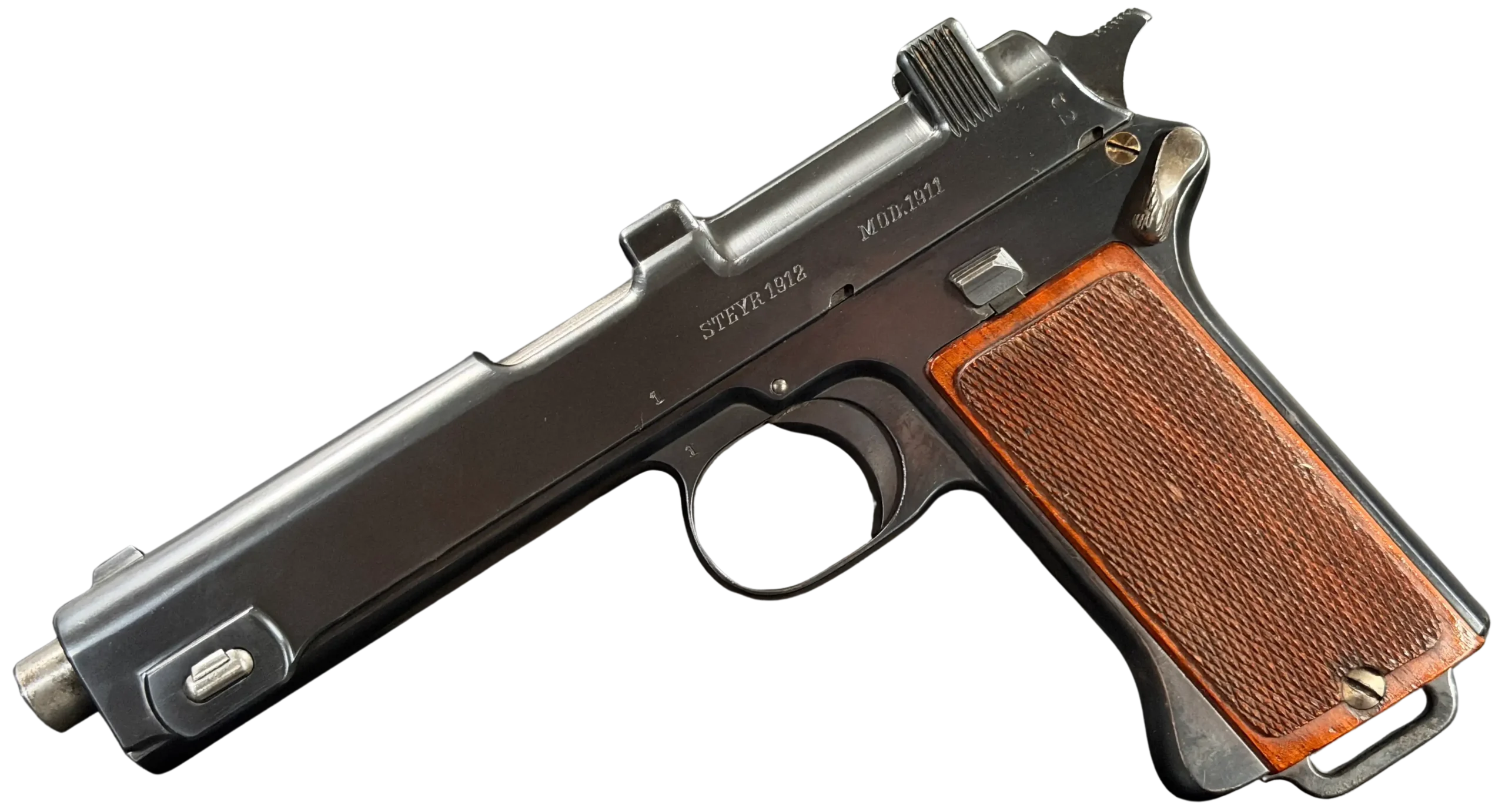
The Steyr-Hahn Model 1912 is the standard service pistol of the Austro-Hungarian Empire, adopted in 1912 and produced by the Österreichische Waffenfabrik-Gesellschaft in Steyr, Austria, to arm the infantry and cavalry forces of one of Europe’s great powers during the final years before the First World War. The designation “Hahn”—German for hammer—distinguishes this hammer-fired design from the hammerless or concealed-hammer pistols of the period, and the “1912” identifies its year of adoption, establishing it as a contemporary of other significant semi-automatic military service pistols of that era.
The Model 1912 uses a rotating barrel locking system in which the barrel rotates to cam locking surfaces out of engagement with the slide, a mechanism that was innovative for its time and differs from both the Browning tilting-barrel and the toggle-lock systems used in contemporary designs. This rotating barrel system produces a notably smooth and positive operating cycle. Chambered in the proprietary 9mm Steyr cartridge—a round with dimensions incompatible with 9mm Parabellum—the pistol was a capable service weapon with good accuracy and reliable function under field conditions.
The Model 1912’s most distinctive feature is its fixed rotary magazine, loaded from the top using 8-round stripper clips. This configuration differs fundamentally from the detachable box magazine that was becoming standard on service pistols of the era, and it represents an evolutionary dead end in pistol design—by the interwar period, detachable magazines had demonstrated sufficient reliability to make fixed magazine designs obsolete for most military applications.
The Steyr-Hahn Model 1912 served throughout World War I with Austro-Hungarian forces and was subsequently used by other nations. It is collected today as an artifact of a vanished empire and as an example of the creative engineering approaches explored during the formative period of semi-automatic pistol development.
Showing the single result
Showing the single result
Available
View Item
Available
View Item
Available
View Item
Available
View Item
Available
View Item
Available
View ItemA clear, hands-on walk through Gen1 to Gen5 Glock differences you can actually see and feel, plus quick ID cues, useful markings, and a 10-minute inspection plan.

A practical collector’s guide to the Winchester Model 70. Quick ID of Pre-64, Post-64, and Classic; CRF vs push-feed; triggers; stocks and barrels; serial dating; and a no-nonsense inspection checklist.
From Tikkakoski’s barrel shop to Sako’s Riihimäki plant, this is the real story behind Tikka’s T3 and T3x. We cover actions, barrels, triggers, model lines, and what matters to buyers and collectors.