
You can trace the modern FN story back to a single meeting in Hartford, 1897. A sales manager chasing bicycle tech ran into an old friend with a new kind of pistol. That handshake didn’t just change a company. It set the tone for more than a century of designs that would wear FN’s crest on battlefields, in police holsters, and in civilian gun safes around the world.
The handshake that saved a factory
FN began as a contract house. In 1889, Fabrique Nationale d’Armes de Guerre formed to deliver 150,000 Mauser rifles to the Belgian government from a new plant in Herstal, Belgium. The first rifles rolled out on New Year’s Eve 1891, a festive start for a factory built for precision work and big orders.
But contracts ebb and flow. To keep machines humming in slow years, FN branched into ammunition and even bicycles. In 1897, FN sales manager Hart O. Berg sailed to America to study bicycle trends and bumped into John Moses Browning in Hartford. Browning wanted help building a self-loading pistol. FN saw the future and signed on July 17, 1897. That partnership ran for three decades and, by FN’s own telling, it kept the lights on and the payroll met.
From Mausers to the first successful Browning auto pistol
Out of that new collaboration came the .32 ACP Model 1899, the first commercially successful self-loading pistol. In Europe it was simply le Pistolet Browning. When your first swing clears the fences, you don’t need a fancy name. FN then refined the design into the Model 1900, incorporating feedback from the Belgian military, which asked for a slightly larger frame, revised grip plates, and a lanyard loop. FN built more than 700,000 of the Model 1900, most for civilians. That is a staggering number for the time and proof that the public had embraced the idea of a reliable pocket auto.
The Browning connection would continue to shape FN for decades. If the 1899 and 1900 proved the concept, later Browning designs built the legend. For readers who enjoy the early Browning autoloaders, I’ve written a separate look at the Browning Auto-5 history and care, and a collector-focused guide to the Browning Hi-Power’s pre-war and post-war variants. They are companion reads to this broader FN story.
Factories and proofs: the quiet language stamped in steel
Collectors chase stories, and the most honest ones are stamped right on the gun. FN’s story starts in Herstal, so Belgian-made FN firearms generally carry markings that reflect that birthplace. Belgium has long required proof testing before sale, which means Belgian-built guns typically bear national proof marks showing they passed pressure testing prior to leaving the factory. If you are evaluating a vintage FN, those small crowns, ovals, and letters on the barrel flats and slide recesses are more than decoration. They help you sort out when and where a gun was made, and sometimes even provide a breadcrumb trail of its commercial life.
On modern guns, markings can tell you not only the origin but also the distribution path. In the U.S., for example, FN America serves the commercial market. Model designations, caliber callouts, and serial prefixes often differ slightly between defense-contract runs and commercial SKUs. If you are shopping, compare the roll marks, import or distributor marks, and catalog names against official product pages. FN’s own About FN page is a helpful anchor when you are trying to determine how an advertised gun fits into the larger family.
Two practical tips for buyers and new collectors:
- Photograph all markings clearly before you bid or buy. On older pistols, look under grips and on barrel hoods. On rifles, check receiver flats and barrel shoulders.
- Match the configuration to the markings. Caliber, sights, and furniture should make sense for the period and model. If they don’t, you may be seeing an arsenal update or a later parts swap. That is not a dealbreaker, but it should inform price.
Licensed production: how FN designs traveled
One measure of a design’s strength is how often it is built under license. FN’s catalog has repeatedly met that bar. Several FN small arms were produced by partner factories outside Belgium under agreements that supplied tools, drawings, and know-how. For collectors, this can mean a gun with FN DNA in a locally made receiver, stocked and finished thousands of miles from Herstal.
The upside is a wealth of interesting variants. The challenge is a matrix of markings and small differences. When in doubt, start with the big questions: was the model commonly licensed, is the observed serial range consistent with that country’s production window, and do the proofs and acceptance marks align with the supposed origin. When those puzzle pieces click, you have something special. When they don’t, you may still have a fine shooter, just not the variant it was advertised to be.
Two pillars of the postwar era: FAL and MAG
FN’s postwar reputation rests heavily on two workhorses: the FAL rifle and the MAG general-purpose machine gun. If the early Browning pistols made FN a household name with civilians, the FAL and MAG broadcast that name over parade grounds and motor pools worldwide.
The FN FAL became a standard-pattern 7.62 mm battle rifle for many nations in the Cold War era. Its combination of reliability, adjustable gas system, and practical ergonomics kept it relevant for decades. For buyers and collectors, FAL history means a maze of national patterns and licensed builds. Parts kits, arsenal rebuilds, and civilian-legal configurations show up regularly. The constant is the FN design underneath it all.
The FN MAG filled the general-purpose machine gun role with a rugged belt-fed that could sit on a tripod, ride a pintle on a vehicle, or sling from a bipod. The theme is the same: clear usability, broad acceptance, and a design that scaled from infantry use to mounted roles.
Why mention these two in a buyer-forward story? Because they set FN’s tone after World War II. When you handle a later FN rifle or pistol, you often feel the same priorities at work: durability, sensible controls, and support for long service lives.
The 5.7 thread: FN Five‑seveN and what it means for buyers
Fast forward to the late 20th century and you find FN doing the familiar thing again: pairing a new cartridge with a purpose-built platform. The 5.7×28 mm round was developed by FN Herstal, and the company’s own Five‑seveN pistol gives shooters a compact way to run it. FN notes that the Five‑seveN has logged two decades with allied militaries, global law enforcement, and civilian shooters. You will see that longevity reflected in the wide base of available holsters, magazines, and support gear.
The current commercial Five‑seveN lineup keeps the concept modern. FN highlights a chrome-lined, cold hammer-forged barrel, an internal hammer with a smooth, predictable break, and models in black and flat dark earth with 10 or 20 round magazines depending on market. The company is direct about the pitch: improved range and accuracy over common pistol cartridges with minimal felt recoil. If you want the manufacturer’s view of the platform, FN maintains a detailed Five‑seveN product page.
Buyer notes on the Five‑seveN:
- Ammunition: The 5.7×28 mm is a specialized round. Availability and price fluctuate more than 9 mm. Plan your ammo budget and check local shelves before you commit.
- Use case: The pistol is light for its size, with mild recoil and high magazine capacity where legal. It shines in range roles and certain defensive niches. Train to the platform; it rewards familiarity.
- Configurations: FN has offered variants in different finishes and magazine capacities to match local laws. Confirm the exact SKU, especially if you need 10-round magazines.
SCAR and the modern commercial lineup
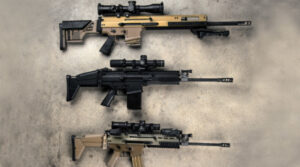
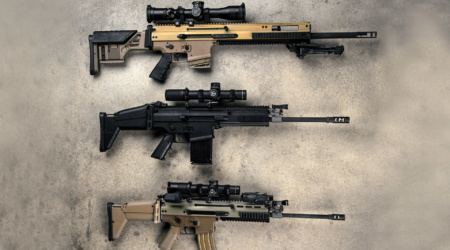
Ask a new FN buyer what drew them in and you will hear the same four-letter answer. SCAR. Since 2008, FN’s modular rifle family has been a fixture in conversations about reliable, gas-operated semi-autos. FN America recently announced a refreshed SCAR series for the U.S. commercial market with more than two dozen updates.
FN calls out several specifics that matter to shooters: a hydraulically buffered bolt carrier to reduce felt recoil, full compatibility with forward-venting suppressors, and endurance testing to 16,000 rounds. Those are not trivial updates; they speak to the way FN treats the commercial space as a proving ground. When a company builds select-fire rifles and machine guns for professionals, the overlap in engineering benefits civilian buyers.
The broader U.S. catalog rounds out with pistol series like the 509, 510, 545, and the Five‑seveN; rimfire training options; the PS90; FN 15-branded AR-pattern rifles; and even factory suppressors. FN America’s site is the best snapshot of the current shelf, and the news section there is useful for gauging what is actively supported versus what is legacy. For a taste of how the company describes its own heritage and approach, the About FN page is worth a read.
Civilian imports: how they reached your local counter
The route from Herstal to your safe can be complicated. Sometimes it is simple: a commercial SKU made for the U.S. market and shipped through FN America’s distribution channels. Sometimes it involves older guns that arrived through importers, or licensed-production variants originally built for another country and later brought in as surplus.
For buyers, the general guidance is consistent:
- Identify the market path. Was the gun built as a commercial model for civilian sale, or is it a licensed or contract variant later imported? The markings will usually tell you.
- Check parts and compliance. Semiauto conversions of military platforms, or civilian-legal configurations of once-selective-fire designs, can involve changes to fire control groups and receivers. If you are unsure how a rifle reached its present configuration, ask for documentation and have a qualified gunsmith inspect it.
- Value what is known. FN’s long reach means variants abound. A clear, well-documented story often matters more than chasing a specific crest or roll mark.
Where FN stands now: a century old and still building
So where is FN Herstal today? The company describes itself as focused on defense and security solutions centered on small arms and ammunition, drawing on 135-plus years of experience and collaboration with users. That continuity shows up in how the catalog evolves: heritage designs supported by new models, and rifles and pistols updated based on feedback from the field.
One corporate note worth flagging for brand watchers: FN Herstal’s parent company recently adopted a new name, drawing directly from its two most recognizable marques. The move from a lower-profile holding name to FN Browning Group was framed as a way to improve clarity and reflect the two brands that built its global reputation. The company explained the change publicly; if you follow the business side, see the announcement about the new FN Browning Group name.
For collectors, that throughline from Browning to FN remains a useful lens. The partnership that began on a summer day in 1897 gave FN a blueprint: combine practical engineering with attentive manufacturing. From the Model 1899 and Model 1900 pistols that helped stabilize the young company, through the FAL and the MAG that defined the mid-century catalog, to the modern Five‑seveN and SCAR families that anchor so many wish lists, the DNA is consistent.
If you are buying, read the markings, learn the variants, and match the gun to your needs. If you collect, keep chasing the stories hiding under slide rails and behind handguards. FN has been around a long time. That leaves plenty of stories left to find.