
The first time you snap open a Webley, the story clicks with the latch. That big hinge upfront, the star extractor flashing as the barrel tips forward, the way it shuts with a confident clack that sounds like duty. It is a motion woven through British service history and Birmingham industry. And it belongs to a name that started far from parade grounds and trenches, in a small foundry making bullet moulds.
Birmingham roots: bullet moulds to percussion guns
Webley’s trail begins in 1790 with William Davies in Birmingham, England, shaping lead moulds that would feed a growing shooting culture. By the mid-19th century the business had passed into the Webley family, and by the 1840s it was doing business as Webley & Son. That shift marks more than a change of signboard. It points to a turn from pure components work toward finished arms, first with percussion sporting guns and then with the revolvers that would carry the name around the world.
The company’s first named production revolver, the Longspur, arrived in 1853. It came out of a period when inventors were racing from cap-and-ball mechanisms into metallic cartridges, trying every plausible path along the way: single and double action percussion, pin-fire experiments, center-fire when the technology matured. Philip Webley and his family kept pushing through each phase. Behind it all was Birmingham’s dense web of skilled trades, where locks, barrels, stocks, and finishes could be honed within walking distance. That ecosystem powered Webley’s rise as much as any single patent.
The Longspur, a merger, and the rise of Webley & Scott
By the 1850s the firm had enough momentum to look outward. Company history notes a merger with W&C Scott & Sons in 1857, creating The Webley & Scott Revolver & Arms Co. in Birmingham. Scott, renowned for sporting guns, brought additional manufacturing reach and a strong foothold with the game-shooting crowd. Together, these names would come to represent two complementary worlds under one roof: service handguns that broke open at the top, and elegant shotguns that broke open at the breech.
Webley’s revolvers were already reaching notable hands. In 1869, a pair of Royal Irish Constabulary (RIC) model revolvers were presented to Major General George Armstrong Custer by Lord Berkeley. The company’s heritage timeline connects those revolvers to Custer’s later service and death at the Little Bighorn. That episode says something about where Webley stood by the late 1860s: firmly on the radar of military men and dignitaries well beyond Britain.
Why the top-break mattered: Mk I through Mk VI
In 1880 Webley unveiled what would become its signature mechanical idea for a fighting revolver: a rugged top-break design, formalized in the Webley Mark I a few years later. Instead of swinging a cylinder out the side, the Webley hinged open at the topstrap. A single motion of the barrel and frame triggered an automatic star extractor that kicked all the empty cases out at once. Under mud, rain, or the last nerve of a nervous recruit, that system was fast, simple, and easy to teach.
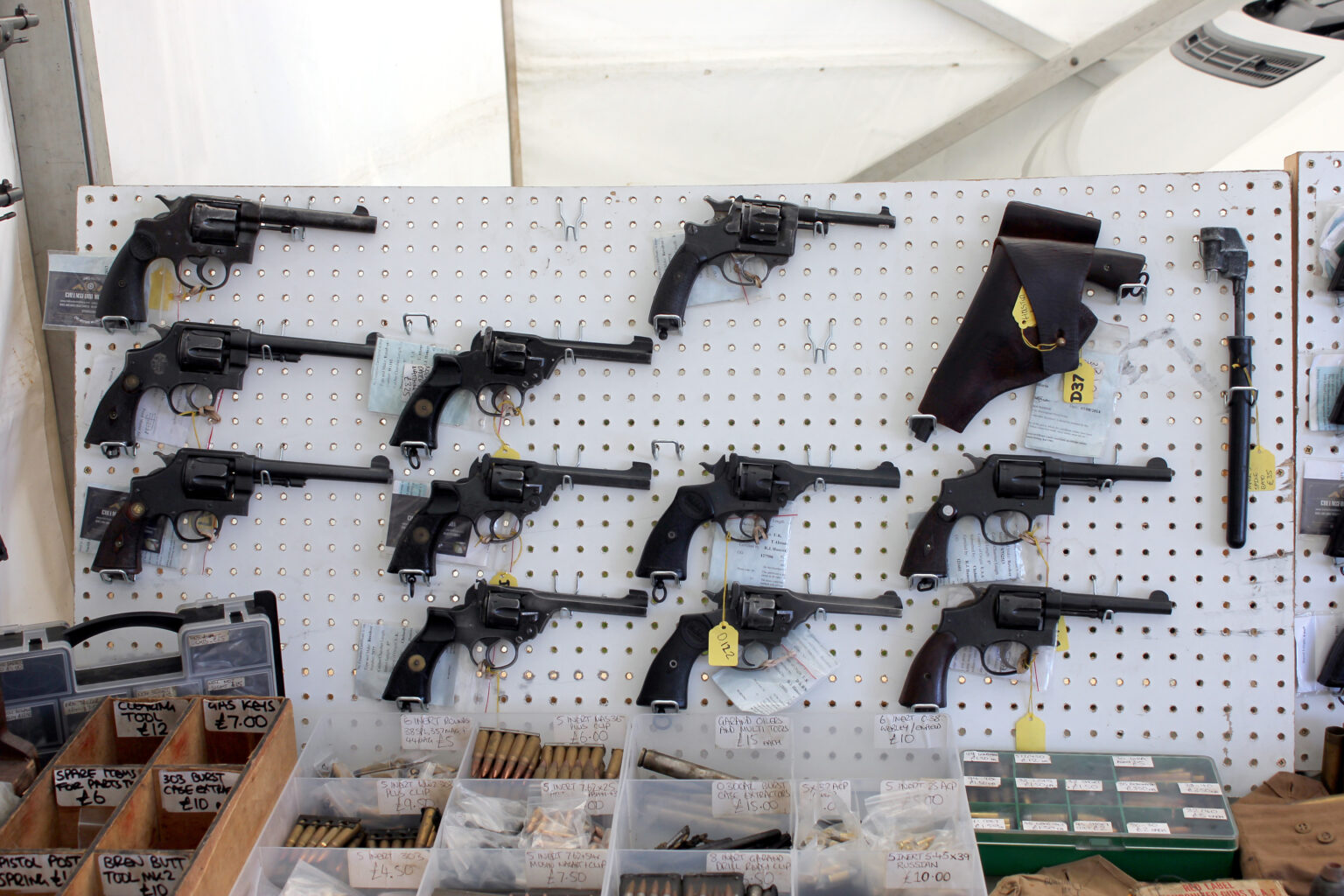
The British military agreed. Webley revolvers were adopted as the official sidearm of British forces in 1887, and they stayed in service in one form or another until the 1960s. The basic architecture persisted through six official Marks, with detail changes across the decades as ammunition, grips, sights, and finishes evolved. Civilians and police saw commercial Webleys in the same period. Those can be a joy to handle, often retaining the clean polish and bluing that hard service wore away from military guns.
If you line up the sequence from early Marks through the Mk VI, you see a company listening to soldiers and armorers. Grip frames grew more hand-filling. Latches and lockwork were tweaked. Sights gained a bit more clarity. Finish shifted toward practical durability. Not everything was romantic; it was a production machine responding to hard lessons.
Cartridges tell the story: the .455 Marks
Webley’s .455 service cartridges read like a short field manual in themselves. The early Mark II was slightly shorter than its predecessor and used Berdan primers, charged with Cordite. The Mark III took a very different turn, using a flat-faced hollow point nicknamed the man-stopper that was intended to dump energy quickly. Then came the Mark IV and Mark V, both pushing a flat-faced solid wadcutter-style bullet. The difference lived in the alloy recipe: the Mark IV used a lead-tin mix, while the Mark V went to lead-antimony. For a soldier or policeman, these shifts affected recoil feel, fouling, and terminal behavior.
By 1939, to comply with Hague Convention expectations about expanding bullets, the Mark VI cartridge standardized on a metal-jacketed bullet. Nobody would call the .455 a magnum. Typical muzzle velocities lived around 600 to 700 feet per second, but with a fat bullet and sensible pressures, it had a reputation for doing enough while keeping mechanical wear realistic.
If you’re buying a Webley today, that little tour of cartridges matters. The Mark stamped on the barrel will tell you what the gun was designed to shoot, which era it belongs to, and often what kind of wear to expect. And if you collect multiple examples, you are really collecting that evolution as much as you are collecting frames and barrels.
The Mk VI in focus: features, wartime service, and Enfield production
The best-known of the service Webleys is the Mk VI. It stands apart with a square-butt grip that fills the hand better than earlier frames, and a matte, dull finish that cut reflections more effectively than classic high polish. It kept the traits people associate with the name: a top-break layout, a big stirrup-shaped latch, a broad front sight you can actually pick up under stress, and that addictive clack when it closes.
When the First World War hit, demand for sidearms spiked. Webley & Scott’s own history notes more than 310,000 Mk VI revolvers made for service use during the conflict. Those numbers tell you why so many survivors exist, and why wartime examples show every level of honest wear. The Mk VI marched through the trenches of the Western Front and later through the sand and smoke of the Second World War.
There is a twist many new buyers miss. After the war, British government production of the Mk VI began in 1921 at the Royal Small Arms Factory at Enfield Lock, following the cancellation of Webley & Scott’s contracts. With the exception of markings, Enfield guns were substantially identical to the Birmingham-built examples. That means a revolver can be a true Mk VI without wearing a Webley-made stamp. Collectors live in the details here, studying property marks and proofs to place a revolver in the right bin.
The Mk VI’s reputation was not built only on battlefields. Webley revolvers swept rapid-fire prizes at the 1913 National Rifle Association meeting at Bisley. Practical accuracy and controllable timing matter in competition, and the design could deliver both in trained hands. For a sidearm drawn from leather and snapped shut on command, that was no small thing.
If you want to see an overview of these features and context from a curatorial angle, the NRA Museum’s profile of the Mk VI lays them out in plain terms, from grip shape to cartridge changes. It is a good companion to a hands-on inspection.
NRA Museum profile of the Webley Mk VI
Webley’s automatics and airguns: a wider portfolio
Webley & Scott did not live by revolvers alone. William Whiting’s automatic pistol design, in .32 caliber, found favor with the London Metropolitan Police and London City Police in 1911. It never displaced the revolver as the British archetype, but it proved the company could cut a reliable self-loader in the calibers police brass liked.
Two years after the Great War ended, Webley introduced the Webley Mark I Air Pistol in 1924, right alongside the 500 Series shotguns. The air pistol seeded a long thread in the company’s story: providing entry points for training and recreation that mirrored the handling of their firearms. It was a clever move for a brand that had supplied military and police for decades. Let people handle a gateway product and the mainline guns will feel familiar when they’re ready.
From war work to game fields: the shotgun chapters
Webley’s name is now as much a sporting gun name as a service handgun name, and that arc is worth following. In 1903 the company developed the .470 Nitro Express double rifle, a cartridge and gun combination that reset expectations for what a dangerous-game rifle could do. That same appetite for big, capable field guns colored their shotgun lines.
By the late 1940s a new era was taking shape. In 1949 Webley began manufacturing the 700 Series side-by-side shotgun, a classic British format with clean lines that fit upland walking as naturally as a tweed coat. A decade later, the firm relocated in 1958 and was acquired by the Windsor Group. That change marks the modern period, when brands with long histories had to find ways to keep classic patterns alive under new corporate umbrellas.
Fast forward and you see another generational reset. In 2010, Webley & Scott AG was formed from Webley, Webley & Scott, and AGS brands. Out of that consolidation came the 900 Series over-under shotguns, with traditional lines and a focus on looks that fit a British name. Later lines followed, including the 1000 Series and 950 Series that arrived in 2016. The company positions these as refined yet attainable, a pitch that resonates with shooters who want the old English feel without falling into bespoke pricing.
If you want to trace the brand’s own telling of its journey, the heritage timeline on the company site is a quick walk from bullet moulds to modern shotguns.
Webley & Scott heritage timeline
Collector and buyer tips: revolvers and shotguns
Reading a Webley revolver
Buying a Webley is a mix of history lesson and parts check. A few pointers help narrow the field.
- Markings first. Military Mk-series revolvers wear government property marks and military acceptance stamps. Civilian guns typically do not. Commercial proofs will be present on civilian sales pieces and on exported revolvers. Those stamps are your map.
- Know your Mark. The model marking on the topstrap or frame tells you where it sits in the sequence. The Mk VI is the most encountered wartime giant, with a square-butt grip and matte finish. Earlier Marks often show more svelte grips and, on commercial pieces, glossier blue.
- Cartridge compatibility matters. Webley service revolvers were designed around .455 service cartridges with performance that tops out in the 600 to 700 fps range. Match the ammunition to the design intent and verify chambering before you shoot any vintage arm. If there is any doubt, have a competent gunsmith inspect it.
- Look for honest service wear. Holster polish on high edges, thinning blue on the backstrap, and rubbed muzzle crowns tell a believable story for wartime guns. If everything is mirror-deep blue yet proofs look washed or edges feel rounded, consider the possibility of a refinish.
- Enfield is not a downgrade. Government-produced Mk VI revolvers from RSAF Enfield are legitimate service guns, substantially identical in design to Webley-made examples. Decide whether you are chasing a maker name or a pattern, and price accordingly.
Coming from the modern double-action world and curious how to think about lockwork timing, cylinder gaps, and finish issues on older duty revolvers? A comparative piece on the Ruger DA ecosystem gives a framework for evaluating wear and mechanical soundness that transfers well to any double action, old or new.
Ruger double actions decoded for practical inspection
Shopping the sporting side
On the shotgun front, Webley & Scott sits in a useful middle ground. Collectors who focus on British side-by-sides know the 700 Series by name. Common-sense tips apply:
- Balance and fit trump rollmarks. Shoulder the gun. Check cast, drop, and length of pull against your shooting style. Classic lines are only useful if the muzzles go where your eyes look.
- Inspect the joints. On any break-action, the locking surfaces and hinge tell you how much life is left. A tight lockup, no rattle at the forend, and clean bite surfaces mean more than new varnish.
- Proofs matter here too. British proof marks will place a shotgun in time and tell you its intended service loads. That can guide what you feed it at the range or in the field.
- Later O&U series like the 900, 1000, and 950 aim for traditional looks with modern build habits. Treat them as shooters first. Ask about spare parts and service availability from the importer or distributor in your region.
For prospective buyers outside the UK, import histories and distributor changes can affect paperwork and support. A quick check with a knowledgeable dealer will save headaches. Vintage doubles should be assessed by a competent gunsmith before use, especially if chambers were lengthened or stocks were altered.
Why the Webley name still rings
Some brands are lucky. They catch a single wave, ride it hard, and fade. Webley & Scott managed to keep catching waves across two centuries, and that is rarer than it sounds. The company grew out of a Birmingham craft scene that could make anything in steel and walnut. It turned that into revolvers that were simple to teach, quick to reload, and tough enough for service across the empire and two world wars. It stepped sideways into automatics when police wanted them, into airguns when training and recreation opened new doors, and into sporting guns where taste and balance matter as much as raw power.
The details are part of the charm. A Mk VI with a square butt and battlefield scars sits under the same roof as a clean 700 Series side-by-side that points like a wand. A .470 double rifle on one rack, a .32 police automatic in a display case, and a 900 Series over-under as a current-production shooter. It is a brand that makes sense to a buyer who appreciates continuity. Not because every product is the same, but because they all spring from a pattern of practical engineering and a willingness to answer whoever was calling: soldier, beat cop, or bird hunter.
In 1958 the firm moved to new facilities and changed hands, and in 2010 the name settled into a new corporate structure with modern shotguns at the fore. Yet you can still open a Webley, old or new, and feel that same hinge-driven conversation with the past. If you are hunting a revolver for the safe or a shotgun for the season, that is the pull. It is not nostalgia for its own sake. It is the satisfaction of owning a tool that solved real problems for real people, and keeps solving them today.
That is what makes a Webley feel a little different when it clicks shut in your hand.