
You can stand in the FN museum in Herstal and feel the echo of a quiet November afternoon in 1926. A man collapses at a workbench while sketching a new pistol. He is John Moses Browning, and the unfinished drawing in front of him would grow into one of the most influential sidearms of the 20th century. That moment is not just a footnote. It’s the hinge where FN Herstal’s past and future swing together.
For buyers and collectors, FN is more than a name on a slide. It’s a trail of factories, proof marks, export stamps, and model lines that leads from 19th-century Belgium to a South Carolina assembly line and back again. Follow that trail and you can tell, often at a glance, where a gun was born, who it was built for, and how FN’s engineers were thinking that year.
Belgium, 1889: A Factory, Mausers, and Ammunition
FN began with a contract, not a brand idea. In 1889, a new company in Herstal agreed to produce 150,000 Mauser rifles for Belgium, along with 30 million cartridges. That double mandate mattered. FN chose to take on ammunition production alongside rifles, a decision that built expertise into the foundation of the firm. Over the next century, those twin lines would weave together again and again in FN’s story.
That ammunition capability never went away. Today, FN’s ammunition production remains in Belgium, with metal components like cases and projectiles centered in Herstal near Liège and pyrotechnical elements, including primers and certain projectiles, produced in Zutendaal. The split reflects a century of industrial refinement and a relentless focus on keeping firearms and ammunition on speaking terms.
FN’s reputation in NATO calibers came from more than marketing. The company contributed to the design of the 7.62×51 NATO projectile and was selected as the designer of the 5.56×45 NATO SS109 ball and L110 tracer rounds. FN produced the reference batch of 12.7×99 NATO cartridges and was the first company to receive NATO qualification for 5.56 ammunition production lines. More recently, FN’s 5.7x28mm caliber joined the NATO family. For buyers, this means FN is often working at the place where chamber pressure charts, metallurgy, and troop requirements intersect.
Meeting Browning: 1897 and the First Wave of Autoloaders
FN’s step beyond contracts into design came with a handshake. In 1897, FN sales manager Hart O. Berg traveled to the United States to study bicycles. In Hartford he ran into an old colleague: Browning. Browning was then aligned with Colt and looking for help building a new self-loading pistol. FN saw what others did not and became his European manufacturing partner that summer. The collaboration changed both names forever.
Not long after, the team brought out the FN Model 1900, often cited as the world’s first true pocket automatic. This was more than a novelty. It signaled that Herstal could take an American sketch and turn it into Belgian steel at scale, while refining the concept into a line of reliable pistols and long guns that defined how early automatics should look and feel in the hand.
The Last Sketch: Browning’s 1926 Passing and the Hi-Power Era
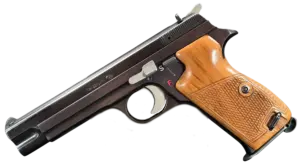
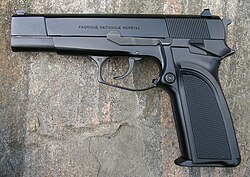
On November 26, 1926, Browning died at his FN workbench while developing what would become the High Power pistol. The project didn’t stop. It passed through the hands of FN’s own engineers, who carried it across the finish line. The Hi-Power would go on to serve globally, and the pistol’s DNA is exactly what you would expect from a Herstal-Browning story arc: human-centered ergonomics, strong service life, and a balance of capacity and control that felt ahead of its time.
If you collect or shop for Hi-Powers, you learn that each era tells on the frame. Early-production features differ from later safety systems; finishes change over decades; import marks appear and disappear with trade routes. If you want a practical primer on eras and variations, see our detailed piece on collecting the Browning Hi-Power from T-Series to Mk III. Understanding the lineage helps you buy with confidence, avoid mismatched parts, and appreciate the pistol in context.
Saive’s Postwar Answers: FN-49 to the FAL
After World War II, FN rebuilt and went back to what it did best: blending industrial discipline with inventive design. Engineer Dieudonné Saive, Browning’s colleague and a gifted designer in his own right, led development of two rifles that defined the mid-century: the FN-49 autoloading rifle and its successor, the Fusil Automatique Léger, better known as the FAL.
The FN-49 carried the idea of a refined, service-ready semiautomatic battle rifle into the postwar moment. The FAL did something more. It rode the wave of new NATO standards and evolving infantry doctrine, becoming one of the world’s archetypal selective-fire 7.62 rifles. Different countries configured it their own way, but the heart of the rifle carried Herstal’s approach: reliability first, parts that interchange cleanly, and manufacturing that could be licensed or supported for export customers.
FN’s Machine Guns and NATO Ammunition Fingerprints
FN’s influence often shows up in the gaps between rifles. Consider the FN MAG and the FN MINIMI. These belt-fed machine guns became widely fielded in NATO and beyond, and they illustrate a pattern: FN designs weapons and ammunition with a shared lab bench. When a company builds both, it sees the whole picture. Ballistics labs in Herstal don’t just test guns; they feed cartridge data back into the next engineering meeting.
For buyers considering surplus or commercial variants, that cross-pollination explains why FN-branded guns and ammo tend to play well together. It’s not a hard rule, and it’s not a claim of perfection, but it’s a meaningful nudge when you’re choosing loads for a rifle you plan to run hard.
Factories and Where Things Are Made: Belgium and South Carolina
FN’s home is still in Herstal, near Liège. That’s where the history is oldest and where ammunition production handles metal components. Pyrotechnical work, including primers, lives in Zutendaal. But the brand’s footprint extends well beyond Belgium. In the United States, FN America builds for the commercial, law enforcement, and defense markets from a facility in South Carolina. Even specialized systems slated for American users have been scheduled for production there.
As a buyer, this matters because markings tell you where a gun was made and which market it targeted. A rifle or pistol produced in Belgium typically shows that heritage in rollmarks and, when applicable, local proofs. U.S.-market models built by FN America will reflect their South Carolina manufacture. If you’re comparing two otherwise similar guns, the origin can sway parts compatibility, finish details, and collector interest.
FN’s American footprint has grown alongside its product lines. To see how the U.S. arm frames its mission and manufacturing presence, the company’s own overview is a useful read on About FN America.
Proofs, Marks, and What Buyers Should Look For
Collectors love FN partly because the metal talks. Factory marks, contractual markings, and later import stamps can help place a gun in time and space. While specifics vary by model and era, a few habits serve you well:
- Start with the big picture. Is the gun clearly aimed at a commercial market, or does it carry features and markings typical of a government contract?
- Read the origin lines. Country of manufacture and importer information, when present, quickly sort Belgian-built examples from U.S.-built ones.
- Document what you see. Quality photos of all rollmarks and acceptance marks will help you cross-check against authoritative references for your specific model.
- Be cautious with refinished or assembled-from-parts guns. FN’s long production life means components can drift between eras. Verify that parts and finishes make sense together.
Because proof and acceptance practices differ by market and changed over time, it’s wise to confirm details for the exact model and year you’re considering. When in doubt, talk with a knowledgeable smith or a specialist who handles FN pistols or rifles routinely. Good documentation and patience beat guesswork every time.
Product Lines: Military, Security, and Commercial
FN’s catalog sits on three legs. There are defense solutions targeted to armed forces. There are security solutions for law enforcement. And there is the commercial catalog aimed at private buyers. While the history-minded among us focus on the older guns, it’s worth paying attention to how the modern company presents itself because the silos explain some differences you’ll see between variants of the same model.
On the defense and security side, FN shows everything from grenade launchers to optics like the new, military-grade micro red dot sight designed for duty users. These products are sold to agencies and, as the company notes, are subject to export approvals. Meanwhile, the security pistol roster includes new handguns like the 9×19 FN HiPer, which emphasize ergonomics, reliability, and contemporary safety systems for professional users.
On the commercial side, guns are tuned to the realities of private ownership. Triggers, accessory support, and configuration options are framed with shooters and collectors in mind. If you’re shopping new-in-box, factor in which lane your target model runs in. Duty-focused features make sense for some buyers; others may prefer the commercial variant’s furniture or controls.
SCAR to Present Day: Modular Rifles and Modern Upgrades
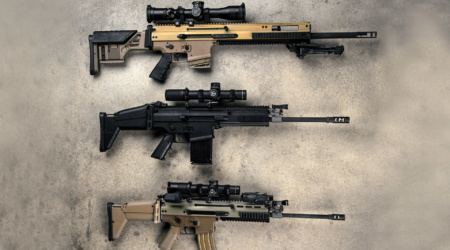
FN’s SCAR family arrived in the late 2000s and brought the brand’s modular-rifle thinking into the mainstream for American buyers. Since 2008, SCAR variants have been fixtures in both service and civilian circles. The latest U.S. commercial series adds a hydraulically buffered bolt carrier to soften felt recoil, comes ready for forward-venting suppressors, and carries a long test pedigree. Those are the kinds of quiet updates that tell you FN’s engineers are listening to end users and refining the platform over time.
If you’re comparing SCARs across years, look beyond color and barrel length. Pay attention to carrier updates, gas system tweaks aimed at suppressed use, and factory provisions for optics and accessories. The more recent models fold in lessons learned from both agency and private shooters over a decade and a half of hard use.
FN Across Borders: Exports, Technology Transfer, and the Group
FN’s reach lives not only in finished guns but in knowledge that travels. The company has long supplied weapons to allied services and also supports partners who want domestic production capacity, particularly for ammunition. Building out that capability helps nations reduce foreign dependence and keep costs in check over the life of a weapon system. FN frames this as technology transfer, and the company’s own materials outline how it supports governments that seek to stand up local lines for cartridges and related components. If you’re curious how that works at a high level, FN’s perspective on ammunition technology transfer explains the rationale.
Step back and the picture gets broader still. FN Herstal is part of the Herstal Group alongside Browning and Winchester Firearms. That corporate family ties the Belgian factory floor to some of the most recognizable names in American sporting arms. It also creates a shared pool of manufacturing knowledge that shows up in better triggers, improved coatings, and the kind of quiet running changes that make a gun easier to live with year after year.
Buyer and Collector Notes: Reading the Metal Without Myths
Every FN has a story. The trick is to hear it clearly. Here are practical notes that have served me well at gun counters and auction tables:
- Model context matters. A prewar pocket auto, a postwar FAL, and a modern SCAR follow different rules. Start by understanding where your target model sits in FN’s timeline.
- Factory and market channel shape the details. Belgian-built commercial pistols can differ in markings and finishes from U.S.-market guns produced in South Carolina, even when the model name matches.
- Ammunition pairing is not an afterthought. FN’s long work on NATO calibers is more than marketing copy. When in doubt with a new-to-you rifle, begin with well-documented loads that mirror intended service ammunition.
- Condition stories should make sense. If finish wear points don’t match how a gun is supposed to be carried or stored, pause. FN’s machining and finishing quality make inconsistent rework easier to spot.
- Documentation is a force multiplier. For classic pistols like the Hi-Power, era-specific resources and knowledgeable armorers are worth their weight. A careful read can save you from a costly parts mismatch.
I’ve always thought of FN as a house that guards its blueprints closely but leaves breadcrumbs on every finished gun. From the 1889 rifles and cartridges to the SS109 and modern optics, the company kept returning to the same theme: make the weapon and the ammunition talk to each other, test relentlessly in-house, and build at a level that stands up to institutional use.
If you’re buying a piece of that history, older or new, the approach is the same. Handle it. Look for the quiet clues. Read the marks. Then make the call based on what the metal tells you, not the story you want to hear. That’s how FN’s past starts to feel like a compass for your next purchase, and how a sketch on a Belgian workbench can still guide your hand a century later.